
If you’re a local service business running Google Ads and the results feel “okay but inconsistent”, there’s a reason.
It’s almost never because Google Ads “doesn’t work.”
It’s because the account was built to spend, not to convert.
After auditing and managing Google Ads accounts for local service businesses—plumbers, dentists, contractors, clinics—the same issues show up every time. Different niches. Same mistakes.
Here’s exactly what we look at first.
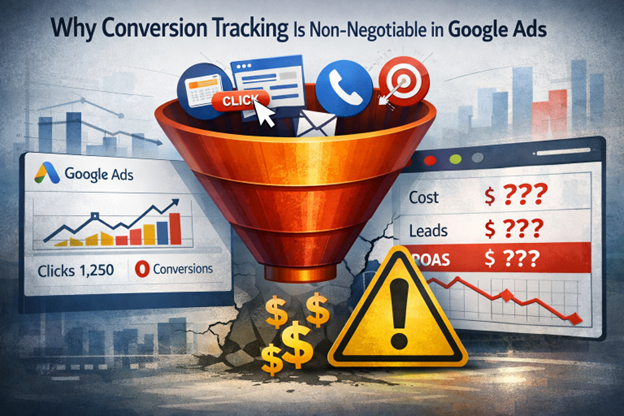
1. Conversion Tracking That Lies
Most accounts have conversion tracking installed.
That doesn’t mean it’s usable.
Common problems we see:
- Every form counted as a lead, including spam
- Phone calls tracked with no quality or duration filter
- Multiple conversions firing for a single action
When tracking is wrong, Google optimizes toward bad data.
That’s how you get “leads” that never answer the phone.
If the data can’t be trusted, nothing else matters.
2. Account Structure That Ignores Search Intent
Local service accounts are often bloated with:
- Too many campaigns
- Overlapping keywords
- No separation between high-intent and research traffic
Someone searching “emergency plumber near me” should never be treated the same as “how much does a plumber cost.”
When intent is mixed, budgets leak and CPAs quietly climb.
3. Search Terms Bleeding the Budget
Keywords don’t spend money.
Search terms do.
In most accounts, we find:
- Broad matches pulling irrelevant jobs
- “Cheap,” “DIY,” or competitor research traffic
- Little to no negative keyword strategy
This is where 20–40% of spend disappears without anyone noticing.
Fixing this alone can dramatically improve results without increasing budget.
4. Budget Allocation With No Business Logic
Many local accounts split budget evenly “to be fair.”
That’s not strategy.
High-intent, high-margin services should get priority.
Low-value or informational traffic should be controlled or excluded.
If your best services are underfunded while low-quality clicks run all day, the account will look busy and still underperform.
5. Signals You’re Feeding Google
Google doesn’t think. It reacts.
If you feed it:
- Poor lead data
- Inconsistent conversion signals
- No clarity on what a “good” lead is
It will optimize exactly as instructed—just not how you intended.
This is why many local accounts can’t scale without falling apart. The foundation was wrong from the start.
Why This Matters More Than “New Campaigns”
When performance drops, most agencies respond by:
- Launching new campaigns
- Testing more keywords
- Changing bidding strategies weekly
That’s movement, not progress.
If the fundamentals above aren’t fixed first, you’re just rearranging the problem.
Final Thought
Local Google Ads don’t fail loudly.
They fail quietly—through wasted spend, low-quality leads, and business owners assuming the platform is the problem.
It usually isn’t.
If you’re already spending on Google Ads and results feel unpredictable, an account audit will show exactly what’s broken, what’s wasting money, and what to fix first.