
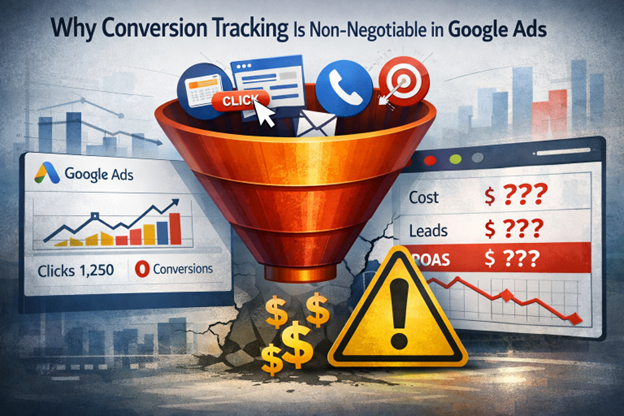
If your Google Ads conversion tracking is wrong, incomplete, or guessed, nothing else you’re doing matters.
Not your keywords.
Not your bidding strategy.
Not Google’s “smart” automation.
You’re making decisions with bad data and bad data doesn’t just slow growth. It actively burns budget.
Google Ads without tracking is guessing with money
Google Ads is built to optimize toward whatever you define as a conversion.
If you don’t define value correctly, Google will still optimize, just toward the wrong thing.
That’s how businesses end up with:
- Plenty of clicks but no revenue
- “Leads” that never turn into customers
- Rising costs with no clarity on what’s working
That’s not testing. That’s gambling.
Clicks don’t matter. Outcomes do.
A common mistake is tracking easy actions instead of meaningful ones:
- Page views
- Button clicks
- Low-intent form fills
- Unqualified phone calls
If every action is treated as equal, your data is lying to you and Google is learning from that lie.
Bad tracking trains Google to fail
Smart bidding and automation rely entirely on conversion data.
When tracking is flawed, you’re teaching Google to chase low-quality traffic at scale.
That’s when you see:
- Performance Max turning into a black box
- “It worked before, now it doesn’t” confusion
- More spend with worse results
Automation doesn’t fix bad inputs. It amplifies them.
What proper conversion tracking actually enables
Correct tracking lets you:
- Optimize for quality, not volume
- Identify what truly drives revenue
- Cut wasted spend with confidence
- Scale without guessing
It turns Google Ads from an expense into a controllable growth system.
Installed tracking isn’t the same as useful tracking
Most accounts technically have tracking.
Very few have tracking that answers:
- Which campaigns make money?
- Which leads are worth pursuing?
- Where quality breaks down?
If your tracking can’t answer those questions, it’s cosmetic.
Why we start with tracking first
Before touching keywords, budgets, or bids, we audit tracking.
Because without reliable data:
- Optimizations are guesses
- Scaling is reckless
- Reports are meaningless
Fix the data, and everything else gets easier and faster.
The bottom line
Most Google Ads accounts don’t fail because of bad strategy.
They fail because no one defined success properly.
If you don’t know what drives profit, Google doesn’t either.
And it will still spend your money — just not intelligently.
Performance Max turning into a black box
“It worked before, now it doesn’t” confusion
More spend with worse results
Automation doesn’t fix bad inputs. It amplifies them.
What proper conversion tracking actually enables
Correct tracking lets you:
Optimize for quality, not volume
Identify what truly drives revenue
Cut wasted spend with confidence
Scale without guessing
It turns Google Ads from an expense into a controllable growth system.
Installed tracking isn’t the same as useful tracking
Most accounts technically have tracking.
Very few have tracking that answers:
Which campaigns make money?
Which leads are worth pursuing?
Where quality breaks down?
If your tracking can’t answer those questions, it’s cosmetic.
Why we start with tracking first
Before touching keywords, budgets, or bids, we audit tracking.
Because without reliable data:
Optimizations are guesses
Scaling is reckless
Reports are meaningless
Fix the data, and everything else gets easier and faster.
The bottom line
Most Google Ads accounts don’t fail because of bad strategy.
They fail because no one defined success properly.
If you don’t know what drives profit, Google doesn’t either.





Hi, this is a comment.
To get started with moderating, editing, and deleting comments, please visit the Comments screen in the dashboard.
Commenter avatars come from Gravatar.